Chapter 17 of 34
Own AreaModel: two million rows without an array
The table only asks for visible cells – so a model can compute values on demand.
After this chapter you can
- extend AreaModel
- make scrolling O(1) with getConstantRowHeight()
- load data page by page from a server
The table only asks for visible cells
chapter 11 (TableModel & areas) showed it: the table asks getRowCount() and getValueAt()
for the cells on screen. So a model doesn't need an array – it can compute each value when asked.
import { AreaModel } from "@guiexpert/table";
const COUNTRIES = ["Germany", "Austria", "Switzerland", "France", "Italy", "Spain", "Poland", "Czechia"];const STATUS = ["open", "paid", "shipped", "cancelled"];const DAY = 86_400_000, START = Date.UTC(2020, 0, 1);
// cheap, deterministic "random" number per row and column (same row → same value, every time)function hash(row: number, col: number): number {  let h = Math.imul(row ^ (col << 24), 0x9e3779b1);  h = Math.imul(h ^ (h >>> 16), 0x85ebca6b);  return (h ^ (h >>> 13)) >>> 0;}
export class TwoMillionRows extends AreaModel {  constructor(private readonly rows = 2_000_000) {    super();    this.areaIdent = "body";  }  override getRowCount(): number { return this.rows; }  override getRowHeight(_rowIndex: number): number { return 34; }  override getConstantRowHeight(): number { return 34; }   // all rows equally high → O(1) while scrolling
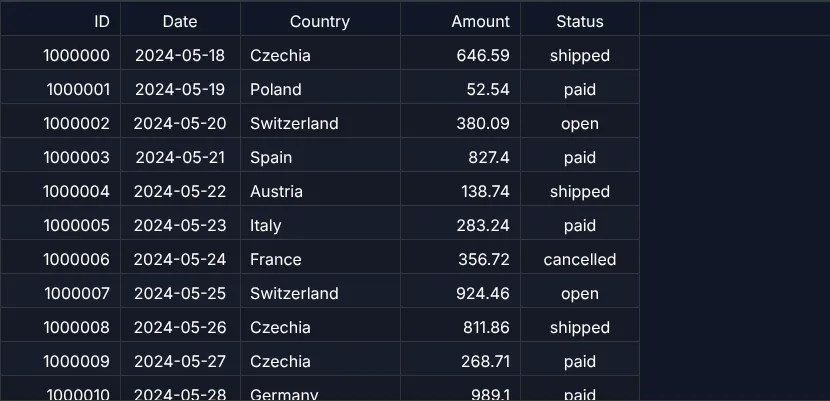
override getValueAt(row: number, col: number): any { // called only for visible cells switch (col) { case 0: return row + 1; // ID case 1: return new Date(START + (row % 2_400) * DAY).toISOString().slice(0, 10); // date case 2: return COUNTRIES[hash(row, 2) % COUNTRIES.length]; // country case 3: return (hash(row, 3) % 100_000) / 100; // amount case 4: return STATUS[hash(row, 4) % STATUS.length]; // status } return ""; }}- Extend
AreaModeland override what you need – the base class has sensible defaults for the rest. getValueAt()is called for about 20 rows × 5 columns per frame, not for 2 million rows.AreaModelIf.getConstantRowHeight()tells the table that all rows are equally high: it finds the first visible row by division instead of adding up heights – O(1) instead of O(n) per scroll frame.
Use it
import {  ColumnDef, EventAdapter, SimpleDomService, TableFactory, TableOptions, TableScope, allRight, bodyLeft, px120, px160} from "@guiexpert/table";
const tableModel = TableFactory.createTableModel({  bodyAreaModel: new TwoMillionRows(rowCount),  columnDefs: [    new ColumnDef("id", "ID", px120, allRight),    new ColumnDef("date", "Date", px120),    new ColumnDef("country", "Country", px160, bodyLeft),    new ColumnDef("amount", "Amount", px120, allRight),    new ColumnDef("status", "Status", px120)  ]});const host = document.querySelector<HTMLDivElement>(".table-div")!;const scope = new TableScope(host, tableModel, new SimpleDomService(), new TableOptions(), new EventAdapter())  .firstInit();const api = scope.getApi();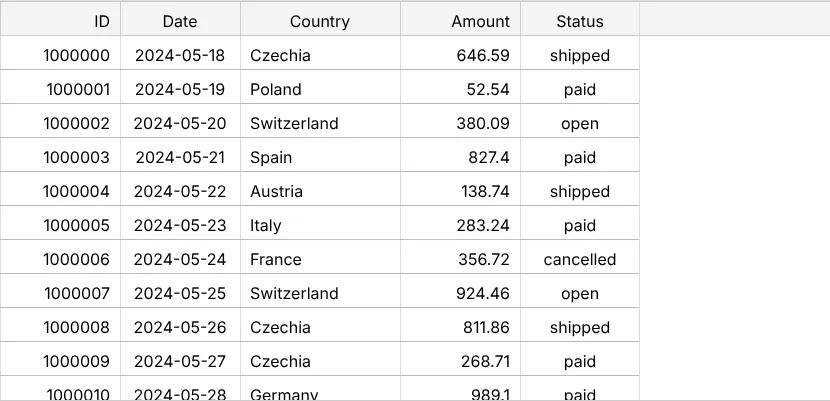
Data from a server, page by page
The same pattern works for remote data: getRowCount() returns the total from the server,
getValueAt() answers from a cache and requests missing pages. When a page arrives, repaint:
import type { Order } from "./data/orders";
/** Sketch: rows come from a server, 100 at a time. */export class PagedOrders extends AreaModel {  private readonly pages = new Map<number, Order[]>();  private readonly loading = new Set<number>();
  constructor(private readonly total: number, private readonly onLoaded: () => void) {    super();    this.areaIdent = "body";  }  override getRowCount(): number { return this.total; }  override getRowHeight(_rowIndex: number): number { return 34; }  override getConstantRowHeight(): number { return 34; }
  override getValueAt(row: number, col: number): any {    const page = Math.floor(row / 100);    const rows = this.pages.get(page);    if (!rows) {      this.load(page);      return "…";                                          // placeholder until the page has arrived    }    return Object.values(rows[row % 100])[col];  }
  private async load(page: number): Promise<void> {    if (this.loading.has(page)) return;    this.loading.add(page);    const res = await fetch(`/api/orders?offset=${page * 100}&limit=100`);    this.pages.set(page, await res.json());    this.onLoaded();                                       // e.g. () => tableApi.repaint()  }}
Sorting and filtering then belong on the server, too – the model cannot sort rows it has never seen.
More
The showcase Large dataset uses the same idea with 2 million rows and renderers; Render speed measures it.
Next
Wide tables: chapter 18 (Fixed columns).